


From the second we dumped the pieces out, my children became completely obsessed with beating their previous height records.
Kids Creative Fort Builder
Kids Creative Fort Builder
Regular price
$19.99
Regular price
$19.99
Sale price
Unit price
per
Couldn't load pickup availability

Kids Creative Fort Builder
Regular price
$19.99
Regular price
$19.99
Sale price
Unit price
per


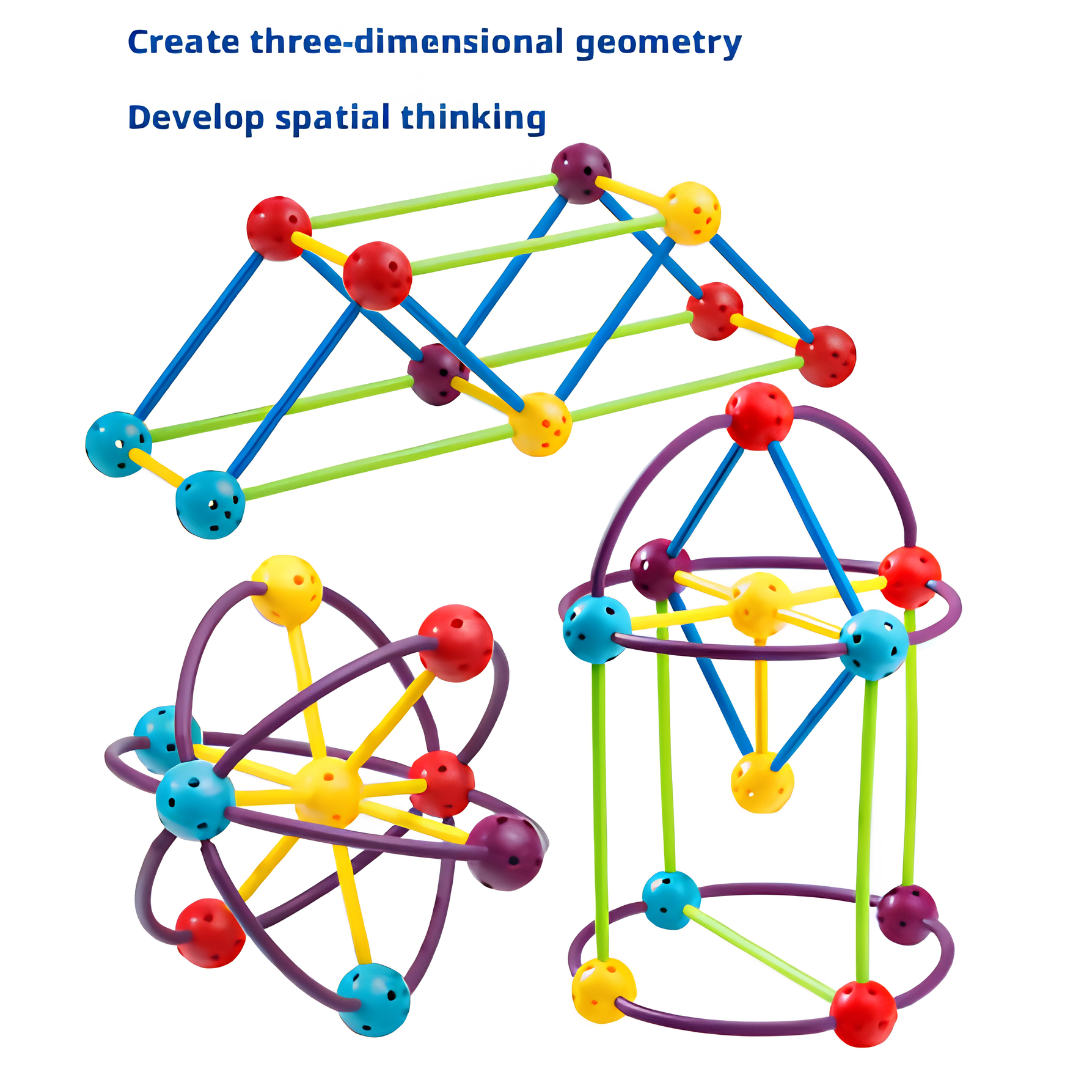

Geometry Building Blocks Kit · 104 pieces
Most construction toys build one thing. This one builds whatever they can picture.
Twenty-four balls and eighty rods in four lengths, including curves. There's no instruction booklet with a finished model on the front, because the point isn't following a plan — it's finding out that a triangle holds its shape and a square doesn't, by pushing on one.
-
Builds up, not just along
Balls take rods from multiple angles at once, so structures go vertical and hold. Flat mosaics become domes and towers.
-
Curved rods change everything
Twenty curves alongside the straights. Arches, wheels and spheres become possible — which is where most rod-and-connector sets stop.
-
Nothing to charge or replace
No batteries, no screen, no sound. It works on a kitchen table in a power cut and it'll still work in ten years.
What's in the box
Four rod lengths, and that's the whole design.
Give someone one length of rod and they build a grid. Give them four lengths plus curves and they start solving problems — because now the shape they want needs the right piece rather than any piece.
24 connector balls
The joints. Each one accepts rods from several directions at once, which is what lets a build carry weight instead of folding flat.
20 curved rods
The pieces that make arches, wheels and rounded shells possible. The first thing most builders reach for once they've made a cube.

60 straight rods, three lengths
Twenty short, twenty-five medium, fifteen long. Mixing lengths is what turns a flat frame into something with depth and proportion.
Non-electric, no harsh chemicals
Moulded plastic and nothing else. Wipes clean, survives being tipped out on a floor, and has no battery compartment to prise open.
Who it's for
Bought for one child. Finished by the whole table.
The thing nobody expects about open-ended construction sets is how quickly the adults join in. There's no winner and no correct answer, which turns out to be exactly why it holds a room.

Something to do together
Building side by side gives you a shared task and something to talk about that isn't a screen. That's most of the appeal for the adult buying it.
Geometry you can hold
Why a triangle is rigid and a square isn't, why a dome stands up. Concepts that are dull on paper and obvious the moment you push on one.
Classrooms and clubs
A single set gives a group a shared problem to solve — build the tallest, the widest span, the one that survives a nudge.
Rainy afternoons
It comes out of the box and stays out. Half-finished structures survive on a shelf and get added to for days.
FAQ
Your questions, answered straight
What exactly is in the 104-piece set?
24 connector balls and 80 rods — 20 curved, 20 short, 25 medium and 15 long. Colours are assorted and supplied at random, so the exact mix of shades varies between sets even though the piece counts don't.
Do we need instructions?
No, and that's deliberate. There's no single model to build, so nothing to get wrong and nothing to finish. Most people start by making a cube, discover it wobbles, add a diagonal, and go from there — the set teaches itself within about five minutes.
How sturdy are the finished builds?
Sturdy enough to lift and move once they're braced. The balls grip the rods firmly, so a triangulated structure holds together — a square frame won't, until you add a diagonal. Discovering that difference is most of the value.
What age is this suitable for?
The manufacturer rates it 14 and over, and that rating exists because the set contains small parts. Younger children do build with sets like this, but that's a judgement for you to make with an adult present — and it isn't suitable at all for anyone still putting things in their mouth. Please don't buy it for a toddler.
Which size should I choose?
The 104-piece set is the one that lets you build something substantial without running out mid-structure — which is the usual frustration with smaller sets. The 39 and 64-piece versions are fine as a first try or a gift, but most people who start small end up buying a second box.
What if it isn't right for us?
Then you get your money back. Every order is covered by our 30-day returns policy — get in touch and we'll sort it out. No hoops, no chasing.
30-day returns
Build with it for a month
If it doesn't hold their attention, send it back within 30 days and we'll refund you.
First hour
Build a cube, then push it over
Make a square frame and press one corner — it folds flat. Add one diagonal rod and it won't. That single demonstration explains why bridges and roofs look the way they do, and it lands harder than any explanation.
First week
Set a problem, not a picture
"Build something that holds a book" works far better than "build a house." An open goal with a real constraint is where the thinking happens, and it's what stops the set going back in the box after one session.
After that
Leave it out
Half-finished structures get added to across several days. A set that lives on a shelf where it's visible gets used ten times more than one packed away tidily after each session.
Two things worth knowing before it arrives.
- Rated 14+ for small parts. Keep it away from anyone still mouthing things, and keep an adult in the room with younger builders.
- Colours are assorted and shipped at random, so the shades in your set may differ from the photographs.
What our happy customers say
-

Putting the sticks into the balls is so easy that my four-year-old can do it by himself. He doesn't need to ask for my help every five minutes, which is wonderful
-

Our whole family sat on the floor building a giant castle together on Friday night. It is a great way for us to spend time together doing something active
-

Because there are over a hundred parts, my two kids never fight over who gets to use them. They can both build their own houses right next to each other in peace